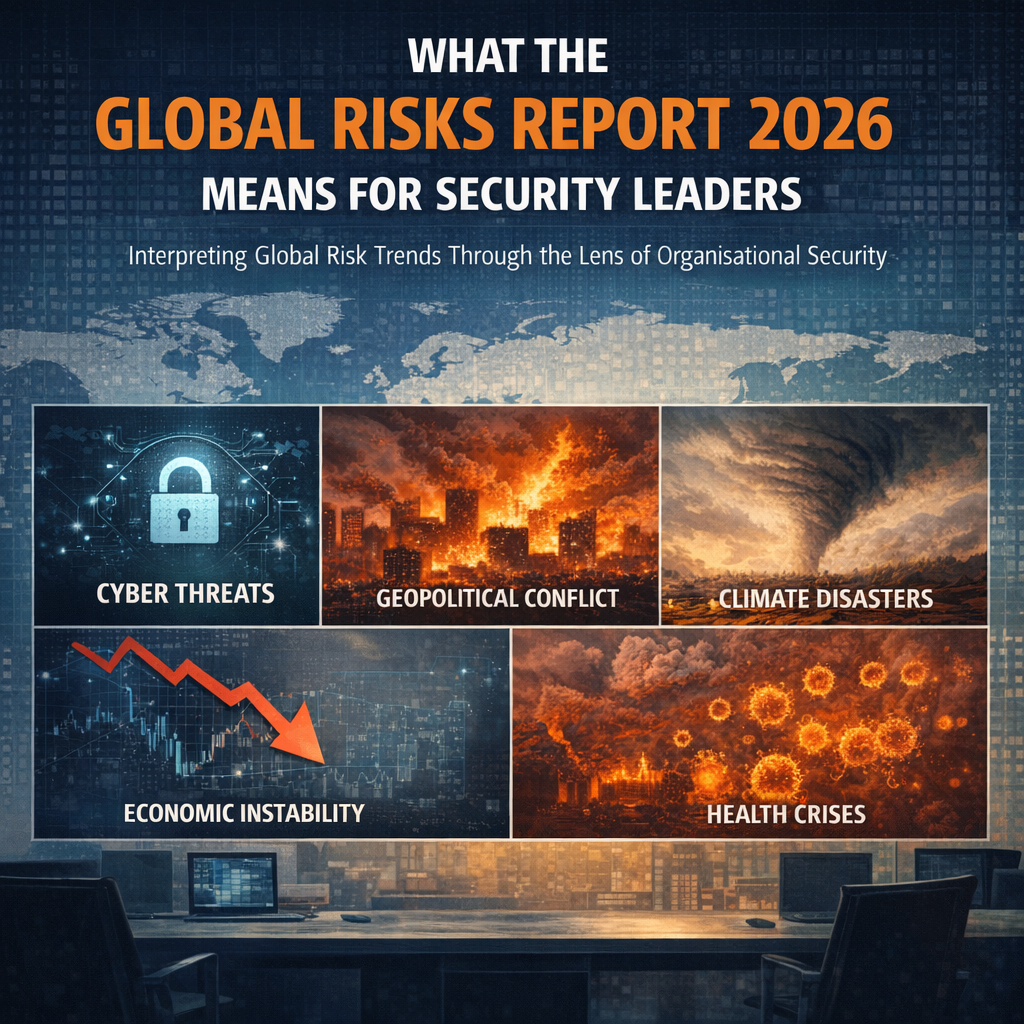
What the Global Risks Report 2026 Means for Security Leaders
Interpreting global risk trends through the lens of organisational security
Half of more than 1,300 global experts anticipate a “turbulent” near future—and just 1% foresee a calm one. That stark outlook from the World Economic Forum’s underscores a crucial reality: today’s security leaders face a world of cascading threats. While the report is often discussed in geopolitical or economic terms, its findings have direct and immediate relevance for the security profession. From intensifying geopolitical rivalry to the spread of disinformation, global risk dynamics are reshaping how organisations protect their people, infrastructure, and operations.
Interpreting global risk trends through a security lens is now a core leadership capability. Security threats rarely develop in isolation. They are shaped by political upheaval, technological disruption, social pressure, and environmental stress. Leaders who understand these macro-level forces can shift from reactive defence to proactive risk anticipation—helping to prevent local crises before they escalate.
Global Risks, Local Impact: A New Security Context
The Global Risks Report 2026 depicts a world entering a more volatile phase. International cooperation is giving way to competition, and global systems are fragmenting—meaning threat conditions can change rapidly. A defining reality for security leaders is that many risks to business continuity now originate far outside the organisation’s walls. A diplomatic standoff or distant natural disaster can quickly reverberate through supply chains, markets, and public sentiment.
Below are four prominent risk domains highlighted in the WEF report—and what they mean for organisational and physical security.
Geopolitical Rivalry and Organisational Exposure
Geopolitical tension is a defining risk of this era. States are increasingly using economic levers—sanctions, trade restrictions, and technology controls—as tools of competition. These geoeconomic confrontations can quickly ripple through operations:
Supply-chain disruption from tariffs, embargoes, or conflict along critical trade routes.
Regulatory volatility as governments abruptly change rules, from data localisation to export controls.
Regional instability where conflict or civil unrest elevates risks to staff and facilities.
For security teams, the mandate is clear: maintain geopolitical vigilance. Tracking international developments and preparing for scenarios such as conflict escalation or sudden sanctions is now essential. WEF survey respondents ranked geoeconomic confrontation as the risk most likely to trigger a near-term global crisis—clear evidence that state-level power dynamics must inform corporate threat assessments.
Information Threats and Misinformation
In today’s environment, information can be weaponised to create real-world security challenges. The WEF report highlights how misinformation and disinformation erode trust and fuel instability—trends that increasingly affect organisations:
Reputation attacks, including false narratives or synthetic media that damage credibility.
Crisis misinformation that spreads rapidly during incidents, undermining response efforts.
Mobilised pressure campaigns that drive protests or boycotts based on distorted claims.
Security leaders are increasingly treating information integrity as a security issue. Collaboration with communications and IT teams is now essential to detect emerging false narratives and coordinate swift, fact-based responses.
Technology’s Double-Edged Sword
Rapid technological change is transforming the security landscape. Tools such as AI and connected sensors offer powerful new protections—but also introduce new vulnerabilities:
Cyber–physical risk, as networked access controls and cameras become targets for intrusion.
Automated threats, where adversaries use AI and bots to scale attacks or bypass defences.
Data exposure, as increased reliance on biometric and sensor data heightens privacy risks.
These realities make close alignment between physical security and cybersecurity essential. Integrating cyber-risk scenarios into physical drills and business continuity planning is now best practice.
Societal Volatility and Operational Resilience
Social and political tensions are contributing to a more unpredictable operating environment. Polarisation, economic stress, and declining trust in institutions are driving unrest that can place organisations in the crossfire:
Protests and civil disturbances affecting high-profile sites or events.
Employee safety risks during political or social flashpoints.
Community backlash linked to corporate decisions or public positions.
This environment reinforces the need for situational awareness beyond the perimeter. Effective security planning now includes monitoring local sentiment and incorporating civil unrest and activist disruption scenarios into crisis plans.
From Awareness to Action
The Global Risks Report is more than an annual list of threats—it is a window into the forces shaping the business environment. For security leaders, the message is clear: translating global risk insight into concrete action is now part of the role.
Organisations that embed global risk awareness into their security strategy, and foster cross‑functional collaboration, will be best positioned to navigate the decade ahead and safeguard their people and operations.